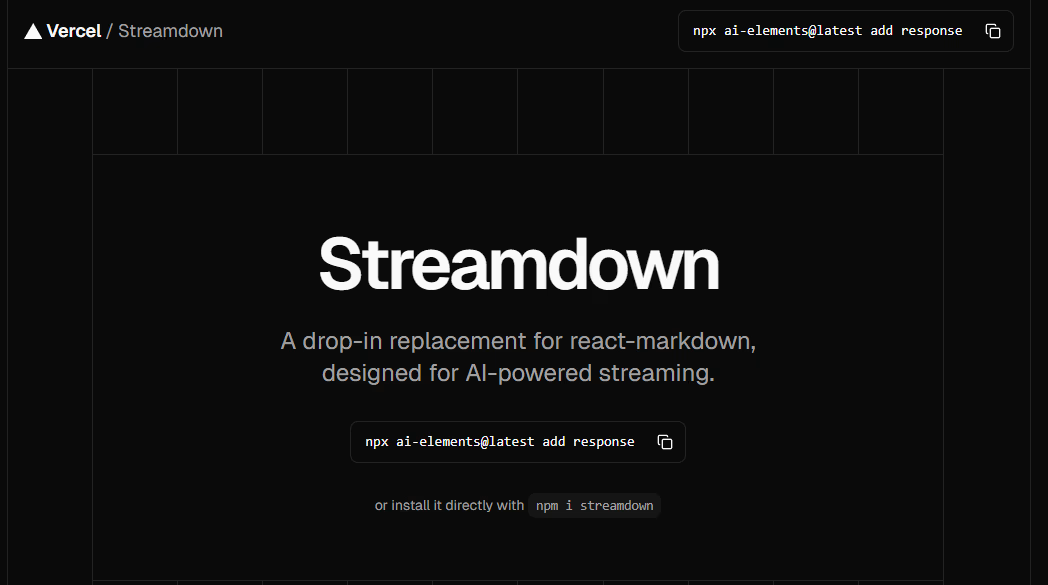
Streamdown by Vercel: Future of Markdown or Overhyped Tool

......
Loading...
Get the Next.js weekly drop
Free weekly notes on App Router, auth, and frontend stacks that ship. No spam—just what's worth your inbox.
By subscribing you agree to our Privacy Policy.
Streamdown: The Future of Markdown, or Just Another Hype?
Markdown has always been my safe space.
I still remember the first time I discovered it—back when I was juggling side projects and needed a way to write clean documentation without drowning in HTML tags. It felt like magic: write in plain text, add a few # and *, and suddenly it transformed into something beautifully structured.
But like every “magic trick,” Markdown had its limits.
And that’s where Streamdown comes in.
Recently, Vercel introduced Streamdown, a new way of writing content that feels like Markdown on steroids—designed not just for documents, but for interactive, real-time, AI-powered experiences.
I’ve spent the past week experimenting with it, and honestly… it feels like a sneak peek into the future of how we’ll all be writing, learning, and sharing online.
In this post, I’ll share:
And at the end, I’ll tell you how you can get updates on tools like this before they go mainstream.
Like many developers, Markdown has been part of my daily workflow for years.
I’ve used it for:
The beauty of Markdown is its simplicity. But simplicity is also its weakness.
Markdown was designed in 2004—before AI, before real-time apps, before the explosion of interactive web experiences. It was built for documents that look good, not ones that do things.
And that’s where I often felt stuck.
But Markdown couldn’t handle that.
Which brings us to Streamdown.
At its core, Streamdown is Markdown—but alive.
Instead of being static text, Streamdown allows you to write documents that can:
Think of it as Markdown + React + AI, all rolled into one.
The name itself is telling: “Stream” for real-time output, “Down” as a nod to Markdown.
Let’s zoom out.
For years, content creation has been split into two worlds:
Streamdown is an attempt to merge those worlds.
That matters because:
In other words, it could make content creation as powerful as app creation.
If you’ve written Markdown, you’ll feel at home.
Here’s a quick example of what Streamdown might look like:
# My First AI-Powered Note

Write a poem about the ocean:

{{ stream.openai.chat(model="gpt-4.1", prompt="Write a poem about the ocean") }}
When you render this, instead of a static block, you’ll actually see the AI streaming the poem into your document.
Want to connect to a database? You can.
Want to fetch live API data? Also possible.
Want to build an interactive tutorial? Done.
It’s Markdown with superpowers.
When I first opened up Streamdown, I had two emotions:
Here’s what stood out after some testing:
If you’re a developer, here’s why you should care:
If you’ve ever felt that the way we share knowledge online is broken—Streamdown feels like an attempt to fix it.
Here’s my personal take:
We’ve entered an era where writing is no longer static. Every piece of text can be:
Streamdown isn’t just another format. It’s part of a bigger trend: the blurring line between code and content.
Just like Markdown lowered the barrier to clean publishing, Streamdown could lower the barrier to building interactive knowledge.
And if that’s true, it could change:
The honest answer: It depends.
I don’t think Streamdown will replace Markdown overnight. But for certain use cases, it’s already miles ahead.
When I first discovered Markdown, it made me fall in love with writing again.
Testing Streamdown brought back that same feeling—like someone just opened a door to a new way of thinking.
Is it perfect? No.
Will it evolve? Definitely.
But does it feel like the future? Honestly, yes.
And that’s why I’m excited.
Because the future of writing isn’t static—it’s streaming, interactive, and intelligent.
I share deep dives like this—mixing personal experience with tech news and tutorials—every week.
👉 If you want to stay ahead of the curve and get tools like Streamdown on your radar before they go mainstream, [sign up for my newsletter].
It’s where I share:
Don’t just read the future—build it with me.